The Price Tag Is Lying to You!
The Number Isn’t the Price. It’s the Pitch.
A one-rupee difference between ₹999 and ₹1000 is not a rounding error. Field experiments on catalogue pricing have found that prices ending in 9 can outsell an identical, slightly lower price by roughly 24%. Nothing about the product changed. Only the digit before the decimal did. That single fact is the doorway into an entire discipline: pricing isn’t math, it’s messaging.
Every number on a shelf, an invoice, or a checkout page has been shaped by someone who understands how the brain reads prices – not calculates them but reads them – the way it reads a face or a tone of voice. Below are five of the most well-documented tactics, with the mechanics behind each one.
01. Charm Pricing – ₹999 vs ₹1000: the left-digit effect
The brain processes numbers left to right and anchors on the first digit it sees. ₹999 is encoded as “900-something,” while ₹1000 is encoded as “a thousand.” The actual gap is one rupee; the perceived gap feels closer to a hundred. This is why the number 9 dominates global pricing – it’s not superstition, it’s a documented cognitive shortcut called the left-digit effect.
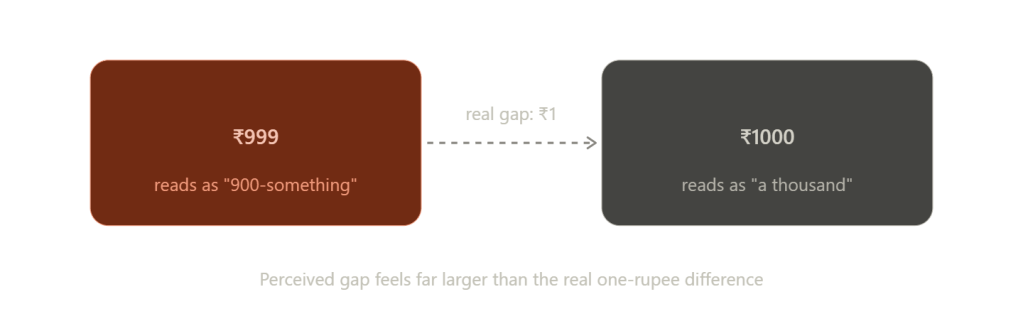
The brain anchors on the first digit – ₹999 clusters with the 900s, ₹1000 clusters with the thousands, even though the real gap is a single rupee.
02. Prestige Pricing – when a higher number sells more, not less
Charm pricing works by making a price look small. Prestige pricing does the opposite on purpose. Luxury brands price in round, high, undiscounted numbers (₹50,000, not ₹49,999) because a whole number signals confidence, and confidence signals value. In categories like perfume, watches, and handbags, price itself becomes a quality cue: the number is doing the job an ingredient list would do for groceries. Demand curves are supposed to slope downward as price rises – prestige goods can flatten or even bend that curve upward, because the price is part of the product.
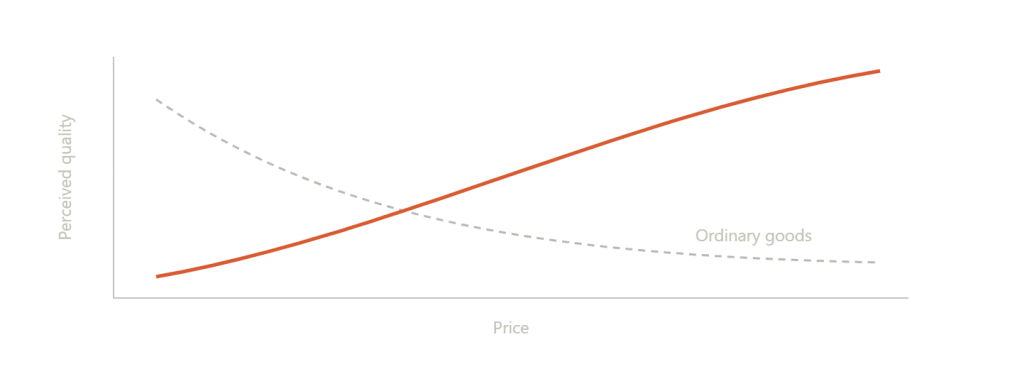
Ordinary demand curves slope down as price rises. Prestige goods bend the opposite way, because the price is doing double duty as a quality signal.
03. Decoy Pricing – the middle option that exists only to disappear
Give someone two choices – a small popcorn and a large one – and they’ll pick based on how hungry they are. Add a third, deliberately unattractive “medium” priced almost as high as the large, and suddenly the large looks like the obvious deal. That middle tier rarely sells. Its entire job is to make the top tier look rational by comparison – a well-known effect called asymmetric dominance, first demonstrated in pricing experiments with magazine subscriptions.
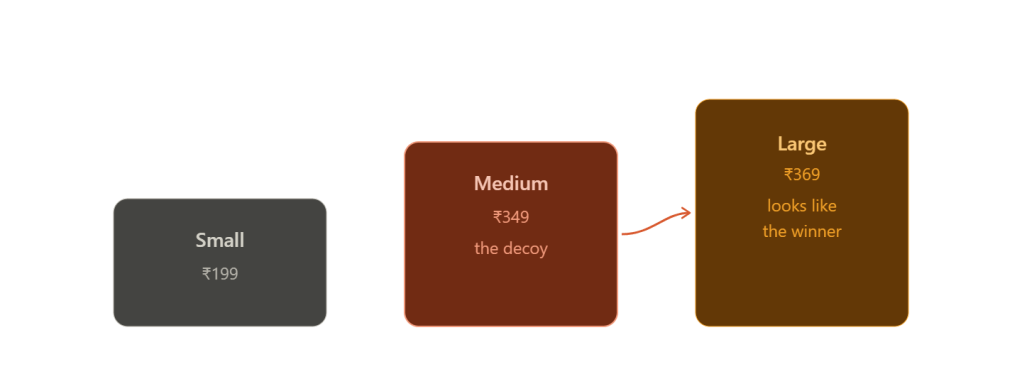
The medium tier is priced almost as high as the large one on purpose – it barely sells, but it makes the large look rational by comparison.
04. Region-Based Pricing – same product, different number, different city
The identical subscription can cost less in Pune than in Manhattan, and less again in Manila than in Pune. This isn’t arbitrage – it’s purchasing-power calibration. Companies price to local income, local competition, and local willingness to pay, then defend the gap with region-locked accounts, currency conversion, or “available in your country” storefronts. The psychology is subtle: within a region, the price still has to feel locally “normal,” charming, or prestige-coded – region pricing is the macro layer sitting on top of everything above it.
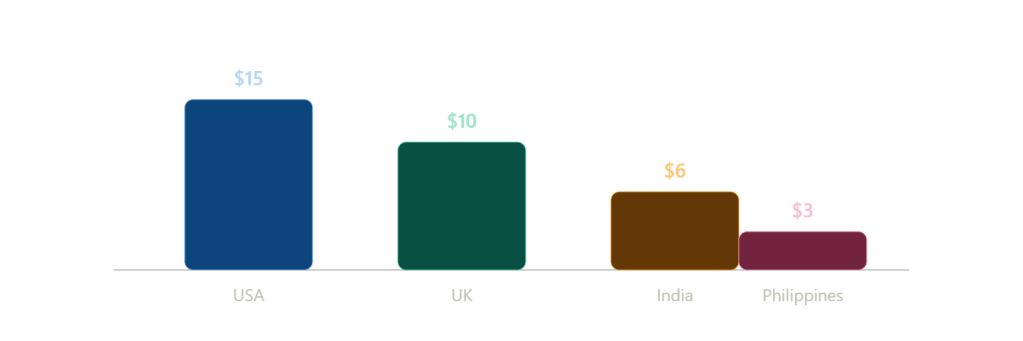
Same product, four different numbers. The prices are calibrated to local purchasing power rather than the cost of goods to make it more accessible to all.
05. Engineered Discounts – the strikethrough is the real product
A “50% off” tag does two jobs at once. First, it sets an anchor: the crossed-out original price tells the brain what “normal” looks like, so the new price feels earned rather than arbitrary. Second, it manufactures urgency through scarcity language – “only 3 left,” “sale ends tonight” – which pushes the decision from the slow, comparing part of the brain to the fast, reactive part. Retailers routinely inflate the “before” price specifically so the “after” price has more room to look dramatic; this is well-documented enough that several countries now regulate how long a price must be offered before it can legally be called a discount.

None of these tactics require deception in the legal sense – the math on the receipt is usually accurate. What’s being engineered is not the number, but the half-second of perception before the brain gets around to checking it. Once you’ve seen the mechanism once, every price tag reads a little differently.
 PsychWear